
- Marzo 13, 2024
- in Pubblicazioni
- by Dr. Giovanni Merolla
- 506
- 0
The number of reverse shoulder arthroplasties (RSAs) has increased tremendously over the last twenty years, with a substantial change from Grammont design to lateralized devices, having the goal of reducing the risk of complications and improve clinical outcomes. Radiographic criteria have been established to evaluate lateralization in RSA and to speculate… Leggi tutto

Reverse shoulder arthroplasty (RSA) has transformed the management of shoulder pathologies, including cuff tear arthropathy and osteoarthritis. The innovative design principles of RSA, such as the medialization and inferiorization of the joint center of rotation, distalization of the humerus, and a semi-constrained construct, enable effective deltoid… Leggi tutto
The aim of this study was to assess the effectiveness of reverse total shoulder arthroplasty (RTSA) with an allpolyethylene glenosphere in patients with failed hemiarthroplasty (HH) or the sequelae of proximal humeral fractures. Methods Thirty-six patients were assessed at a mean followup of 36 months using clinical scores and recording shoulder range… Leggi tutto
Reverse shoulder arthroplasty (RSA) requiring extensive reaming to address severe glenoid bone loss increases the risk of glenoid medialization and baseplate failure. We hypothesized that (1) metal-augmented baseplate prevents the medialization of the joint line and preserves glenoid bone stock similarly to bony increased-offset (BIO)-RSA and (2) bone… Leggi tutto
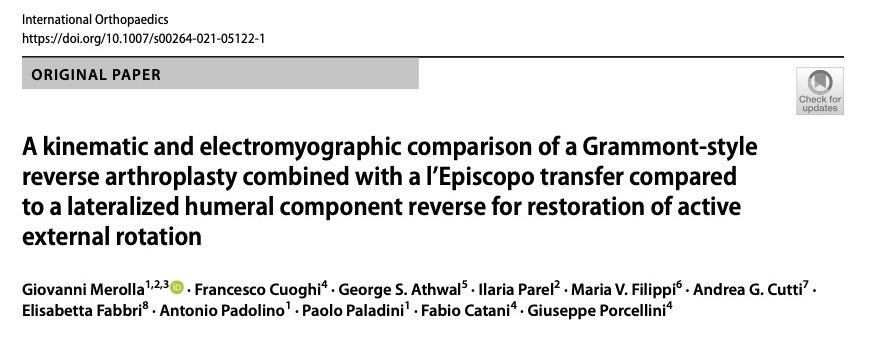
To assess kinematic and electromyographic findings of two designs of reverse total shoulder arthroplasty (RTSA). We tested two hypotheses: (H1) Grammont-style (RTSA) with l’Episcopo tendon transfer gains similar postoperative kinematic findings of a lateralized humeral component RTSA without a tendon transfer; (H2) RTSA with lateralized humeral component… Leggi tutto


